 Dicaria
Who runs France's biggest brands? Reading the French company register
The name on the shop front is not the company that files the accounts. We pulled the registered entities behind three of France's best-known groups and checked what the official register and the global LEI system say about who controls them.
A French brand is usually not one company. Searching the global LEI register for "Danone" returns 28 records, for "Michelin" 11, and for "Renault" 22 — most are subsidiaries, funds and employee committees, and each is a separate legal entity with its own identifier, directors and accounts. For the three groups we checked, the register records the holding-level entity, not the group: Danone's registered entity reports €27.4 billion of revenue for 2025, Michelin's €5.4 billion, and Renault's €57.9 billion, with a €10.8 billion net loss — none of these is the group's consolidated result. The useful question is not "who owns Danone". It is "which legal entity do you need, and does the register show the link to the next one up?" For two of the three, it does not.
One brand, many legal entities
The French register (SIREN) gives every legal entity a nine-digit number. A name search matches active and ceased entities, subsidiaries and sites alike, so a brand name alone does not identify the company. Most of what comes back is not the group. It is subsidiaries, employee committees, investment vehicles and sites.
The entity that matters for a group is usually the one with the accounts and the largest headcount. Here is what the register holds for the three we checked:
| Company (legal entity) | Legal form band | Headcount band | Main activity code | Revenue 2025 | Net income 2025 | Directors on file | Sites (open / total) |
|---|---|---|---|---|---|---|---|
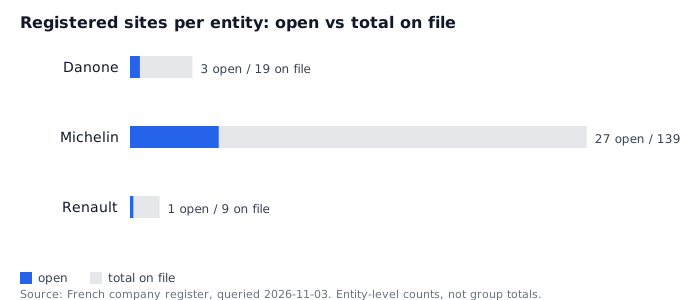
| Danone (DANONE) | Large (GE) | 42 | 70.10Z — head office activities | €27.38B | €2.10B | 13 | 3 / 19 |
| Michelin (MFPM) | Large (GE) | 53 | 70.10Z — head office activities | €5.39B | €0.04B | 6 | 27 / 139 |
| Renault (RENAULT) | Large (GE) | 01 | 64.20Z — holding company | €57.92B | −€10.80B | 18 | 1 / 9 |
Reading the three rows
Each row is a different kind of answer. Read them one at a time.
Danone. The registered entity reports €27.38B of revenue and €2.10B of net income. That is a net margin of about 7.7%, which is a useful signal only for this one legal entity. Thirteen directors are on file. Three of its nineteen sites are open. The activity code is head-office activities, so the entity is the group's top-level holding unit in the register, not its operating business.
Michelin. The registered entity reports €5.39B of revenue and €0.04B of net income, a margin of under 1%. The thin margin does not describe the group. The entity is a head-office unit, and its net income is the result after its own charges, not the consolidated profit of the tyre business. This is the clearest case where a single entity's accounts mislead if read as the company's. Twenty-seven of 139 sites are open, the highest open count of the three.
Renault. The registered entity reports €57.92B of revenue and a €10.80B net loss, a margin of about −18.6%. Its activity code is holding company, and only one of nine sites is open. A large loss on a holding entity with almost no open sites is not a diagnosis. It could mean the entity carries group-level charges, impairments or a historical footprint. The register gives the number, not the cause.
Read across the rows and the revenue figures are not a ranking. Renault's entity reports more than ten times Michelin's, but the register does not say which operating businesses each entity holds. Compare them only as entities, not as companies.
Amounts are the register's yearly figures and are read as euros. The register does not label the currency on each field, so the table keeps the euro sign as a reading, not a certified unit. Headcount is an INSEE band code, not a count. Margins are calculated from the revenue and net income in the table, not reported by the register.
Where the chain goes dark
The LEI system (GLEIF) is the global register that records who owns whom. It is useful, but only where a company has filed its parent.
We checked the direct parent of each entity:
- Michelin: a subsidiary's LEI points to Compagnie Générale des Établissements Michelin as its direct and ultimate parent. The chain exists and it is consistent.
- Danone and Renault: the LEI records for the group entities show no parent filed. The absence is an answer about the filings, not proof that the companies are independent. A group with no filed parent looks identical to a group that never filed one.
That is the real finding. Ownership is only as visible as the filings allow. Searching by name finds 28 Danone-named LEIs, 22 Renault-named and 11 Michelin-named, and most are funds, subsidiaries or committees. Assembling a group chart from them means reading every record, not running one query. The Michelin chain we could follow ran to a single named parent; for Danone and Renault we could not follow a chain at all, because the first link was not filed.
Which entity to look up
When someone asks about a French brand, the first job is to pick the right legal entity. Four checks cover most cases:
- Is the name on the entity the brand? Search results show the registered name, not the trade name. Many brands register under a holding or a manufacturing name.
- Does the entity hold accounts? An entity with a revenue and net income year on file is a reporting unit. An entity without one is usually a site, a fund or a committee.
- Is the activity code a holding or a head office? For Danone and Michelin the code is 70.10Z, head-office activities. The operating business is one or more entities below it. You need the operating entity for operating questions.
- How many of its sites are open? Renault's entity lists 9 sites and 1 open. A high site count with few open sites means the register is holding a history, not a current footprint.
A worked example: why one lookup is not enough
Take Renault. Its entity carries the group's name, reports a 2025 net loss of €10.80B, and lists 18 directors. Read alone, that looks like the group is in serious trouble.
Now check the other two signals. Only one of nine sites is open, which suggests the entity is a shell for a larger structure rather than an operating company. There is no parent filed in GLEIF, so we cannot see whether a larger parent sits above it. The loss could be operating, or it could be group charges booked at this level.
The conclusion we can support is narrow: the entity reports a large loss, and the register does not explain it. The conclusion we cannot support is that Renault as a group lost €10.8B. That is a different claim, and it needs the consolidated annual report.
The same logic applies to Michelin's thin margin and Danone's healthy one. Each is a fact about one entity. The group-level question sits in a different document.
What this file cannot answer
- Who owns Danone, Michelin or Renault. Shareholder registers are not in this data. The register lists officers, not shareholders.
- Group revenue. These are legal-entity figures. Consolidated revenue is in the annual report, and it is often far larger than any single entity.
- Whether a director still holds the role. Officer entries are the register's record, and updates lag.
- Why Renault's entity lost €10.8 billion. The register gives the number, not the cause.
- Which entity in each group is the largest. We checked one entity per company, so this does not establish the largest entity in any group.
FAQ
Can I use this to check whether a French company is a subsidiary?
Why does a name search return so many records?
Is the revenue audited?
Why is the Michelin margin under 1% if the group is profitable?
- Source: French company register (annuaire-entreprises, public search API), queried by SIREN on the same day; GLEIF LEI records for parent links.
- Entities: DANONE (SIREN 552032534), MANUFACTURE FRANCAISE DES PNEUMATIQUES MICHELIN (SIREN 855200507), RENAULT (SIREN 441639465).
- Figures: the yearly revenue and net income the register holds for each entity; 2025 is the latest year on file.
- Derived figures: net margins, and the open-site ratios, are calculated from the table values.
- Limits: legal-entity basis, not consolidated; directors are the register's record; parent links only where filed in GLEIF; the Michelin incorporation date in the register looks like a placeholder, so this article does not use it.
Sign-up comes with a key and an MCP config: ask your AI agent for any French company — the registered entity, its directors, and the revenue and net income years on file.
2,000 free reads included at sign-up; searches and misses are not counted.
Also in this series: France's economy in numbers, from Eurostat