 Dicaria
Europe flagged 4,704 dangerous products in 2025 — and the platform, not customs, did the pulling
The EU's Safety Gate logged 4,704 dangerous-product alerts in 2025. Cosmetics led (1,708), toys followed (730) — and 84.8% of the flagged toys were made in China. But the reasons are specific and testable: choking on small parts, phthalates above limit, lead paint. And for the first time, marketplace takedowns (495) outnumbered border rejections (451).
Europe's Safety Gate logged 4,704 dangerous-product alerts in 2025: cosmetics 1,708, toys 730, electrical appliances 524. Chemical risks caused nearly half (2,328). 84.8% of the flagged toys were made in China — but the reasons are testable, not mysterious: choking on small parts (276 alerts, mostly plush and rattles) and chemical limits (194, mostly phthalates 109 and lead 102). Ordered measures included 495 online-marketplace takedowns — more than the 451 border rejections. The platform has become the customs post.
The year in one table: cosmetics first, toys second
Safety Gate is the EU's rapid-alert system for dangerous non-food products — the successor to RAPEX. Member-state authorities inspect, test and act; every action lands in a public weekly report. Calendar 2025 closed with 4,704 product alerts across 52 reports, which this article aggregates.
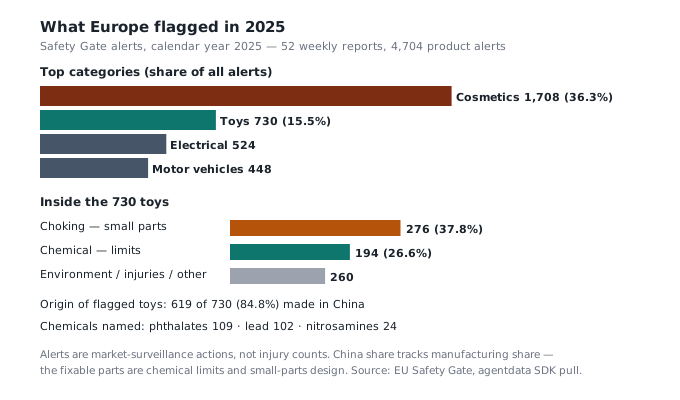
Cosmetics 1,708 (36.3%) lead the table — a steady stream of hair dyes, skin creams and teeth whiteners flagged for banned substances or missing documentation, mostly caught at border or in shops. Toys 730 (15.5%) come second. Electrical appliances (524) and motor vehicles (448) follow.
By risk type, chemical failures account for 2,328 alerts — half the table: banned phthalates in plastics, lead in paint and jewellery, nitrosamines in balloons and cosplay items, unrestricted allergens in cosmetics.
To check your product line against the year's alerts, run the Safety Gate query yourself — every 2025 alert is one query away.
The 730 toys: two different failure modes
The 730 toy alerts split into two problems that have nothing to do with each other — and for a manufacturer, two completely different pre-shipment checklists.
Choking — 276 alerts (37.8%). Soft toys 72, plastic toys 18, rattles 15, plush 10, bath toys 7. This is a design-and-parts failure: a seam that splits, an eye that detaches, a rattle small enough to swallow. It is caught by the small-parts cylinder test, not by chemistry.
Chemistry — 194 alerts (26.6%). Phthalate plasticisers above the REACH limit 109 alerts, lead 102, nitrosamines 24. This is a materials failure: the wrong softener in the vinyl, pigment with heavy-metal content. It is caught by lab testing of the material lot, not by inspecting the finished toy.
84.8% of the flagged toys (619 of 730) were made in China. That number tracks where the world's toys are made, not a quality verdict — the testable claims are the two failure modes above, and both are detectable before shipment.
Who does the pulling: Italy files 26%
Italy filed 1,227 alerts — 26% of the European total, more than Germany (460), France (446) or the UK for Northern Ireland (418). Notification counts measure how actively each authority's market surveillance runs, not where the risk is worst.
The platform is the new customs post
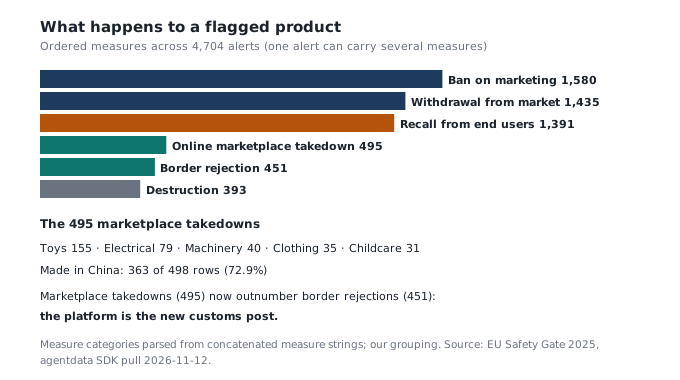
The ordered measures break down as: marketing bans 1,580, withdrawal from market 1,435, recalls from end users 1,391 — and then the notable one: 495 ordered takedowns of product listings from online marketplaces, against 451 rejections at the border.
That crossover is new, and it changes who needs to act. A border rejection reaches one shipment; a marketplace takedown reaches a seller's entire listing — every parallel listing, every fulfilment warehouse. For a cross-border e-commerce seller, the enforcement surface is no longer the port of entry; it is the listing itself, and platforms execute takedowns faster and at scale. 363 of the 498 takedown rows (72.9%) involved products made in China, concentrated in toys (155) and electrical appliances (79).
What this data cannot tell you
- Injuries. Safety Gate logs surveillance actions on product risks, not harm outcomes. An alert is a finding, not a child in hospital.
- The products nobody flagged. Surveillance intensity differs by member state; absence of alerts is not evidence of safety.
- A country quality ranking. Origin shares track manufacturing shares. The testable content is the failure mode: chemical limits and small-parts design, both checkable before shipment.
- Per-brand risk. Brands appear as facts of the record, but alert counts per brand measure enforcement attention as much as product quality.
What is the EU Safety Gate?
How many products did the EU flag in 2025?
What percentage of flagged toys are made in China?
What happens when a product is flagged?
I bought a toy that looks like one of these alerts — what now?
- Source: EU Safety Gate weekly reports via the agentdata SDK; all 52 reports of calendar 2025 pulled 2026-11-12 (4,704 alert rows, zero pull failures). One row = one product alert.
- Category, risk type, country of origin, notifying country and ordered measures are fields of the alert record; measure categories above are parsed from concatenated measure strings — the parsing rules are ours, not the Commission's.
- "Online marketplace takedown" counts rows whose ordered measures include removal of the listing by the marketplace (495 of 4,704 rows; 498 row-measure pairs after splitting multi-measure rows).
- Origin is the product's country of origin as notified; China share (42.9% overall, 84.8% of toys) tracks manufacturing structure and is not a quality attribution.
- Alerts are market-surveillance actions; the dataset contains no injury or harm-outcome field.
All 2025 alerts — category, risk, origin, ordered measures — are one query away. Sign up free and check your product line or your child's toy shelf against the year's findings.