 Dicaria
Microsoft, Google, OpenAI in SEC filings: the names everyone cites, the deals few have
Four AI cloud companies name the same hyperscalers in their SEC filings - and the counts measure completely different things. IREN has 21 self-filed documents naming Microsoft, with one $9.7bn signed cloud contract behind them. TeraWulf names Google 44 times and Google never leased a watt - it backstops someone else's lease. Applied Digital's entire row comes from presentations that call its clients 'U.S.-based investment-grade hyperscalers' without naming any of them. We read the filings themselves.
Counting hyperscaler names inside each AI-cloud company's own SEC filings (2024-2026, fund forms excluded) measures very different things. IREN: Microsoft in 21 documents, one $9.7bn five-year GPU-cloud contract behind them. TeraWulf: Google in 44 documents - as a $1.3bn credit backstop on its partner's lease, not a customer; its real customer is a $19bn, 20-year Anthropic lease signed July 2026. CoreWeave: OpenAI 20, Google 21, Nvidia 19. Applied Digital: a row of 6 or less built from decks naming zero clients.
Every cell in this matrix is a document you can open - pull the filings behind any pair yourself, or watch a new contract enter the register the day it is filed.
A name appears 44 times. How many deals is that?
The word neocloud went from zero to 435 SEC-filing hits in under two years (2023: 0, 2026: 435) - the label for AI cloud providers that are not the old hyperscalers. Once a category exists, everyone in it starts citing the same giants: Microsoft, Google, OpenAI, Nvidia. The citations live in filings, which is good - a company's own 8-K is sworn paperwork. But a name appearing is not a contract existing. Three things can produce a co-mention:
- A signed agreement - the company and the giant are counterparties. This is what a press release means by the word "partnership."
- A credit role - the giant never buys anything; it promises to pay if someone else defaults. Legally heavier than it sounds, economically different than it reads.
- A slide - an investor presentation that names or hints at customers in bulk. Zero contracts by itself, though the leases described may be real.
We pulled every self-filed document (8-K, 10-K, 10-Q, 6-K, S-1, DEF; ETF and fund forms stripped - they contaminate raw counts badly enough to flip cells) naming each pair, counted them, and then read the underlying agreements verbatim. The roles below are only claimed where we opened the document.
The matrix
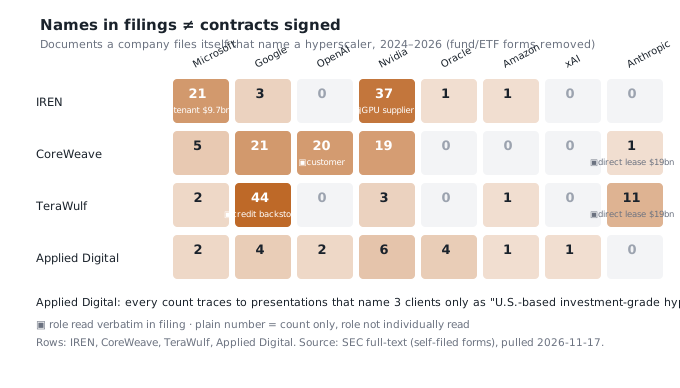
Read the row, then read what the cell is:
IREN x Microsoft - 21 documents, one giant contract. The count concentrates in 8-Ks (14 of 21) that all trace to a single event: the November 3, 2025 announcement of a multi-year GPU cloud services contract worth approximately $9.7bn over five years, with a 20% prepayment, running on NVIDIA GB300 GPUs at IREN's 750MW Childress, Texas campus. IREN simultaneously committed about $5.8bn to Dell for the same machines. IREN's Nvidia column (37) is mostly the vendor side of the same story - GB300 purchase language and financing updates. One customer, one supplier, one supply chain, many documents.
CoreWeave - the balanced book. OpenAI 20, Google 21, Nvidia 19. The OpenAI column has contract texture: a July 2025 8-K closing a $2.6bn delayed-draw term loan "to deliver services under a long-term agreement with OpenAI," with OpenAI's CFO quoted in the same release. Nvidia is shareholder, supplier and customer at once - where we did not read every document we counted documents, not roles. CoreWeave brands itself, in its own press releases, "the AI Hyperscaler(TM)" - the only company in the set that claims the giants' class name outright. Its Microsoft column (5) is IPO-era paperwork - related-party and correspondence sections, not deals.
TeraWulf x Google - 44 mentions, and Google is not the tenant. This is the cell that breaks naive reading. The Google documents (30 of 44 are 8-Ks, from October 2025 onward) describe a joint venture with Fluidstack at Abernathy, Texas: a 168MW campus whose roughly $9.5bn, 25-year lease runs to Fluidstack, while Google signed a recognition agreement backstopping $1.3bn of it - on a Fluidstack default, Google either terminates with a fee or takes over the lease at a discounted rate. A credit insurer, not a customer. Then in July 2026 TeraWulf sold its 50.1% stake in that Google-backstopped venture (monetizing an approximately $450M investment at a premium) and announced what everyone had been reading into the Google column anyway: a 20-year, approximately $19bn direct lease with Anthropic at Hawesville, Kentucky - 401MW, first capacity 2H 2027.
Applied Digital - a deck-only row. Highest cell: 6 (Nvidia). Microsoft 2, Google 4, OpenAI 2, Oracle 4, Amazon 1, xAI 1 - and the dates cluster on two investor presentations (October 2025, April 2026). We opened the April 2026 deck: it describes seven long-term leases with three hyperscalers, about $23bn of expected aggregate rental revenue, 900MW contracted - and names exactly one of them (CoreWeave, 400MW). The other two appear as "U.S. based Investment-Grade Hyperscaler," twice. The Google string inside that deck is an industry statistic ("Google request: 0.3 watt-hours"), not a customer. Applied Digital's filings are honest about the leases; the unnamed part is a marketing choice. Which is exactly why counts alone mislead: a company that names everyone and signs nothing outscores one that signs three and names none.
5 contracts, 5 structures
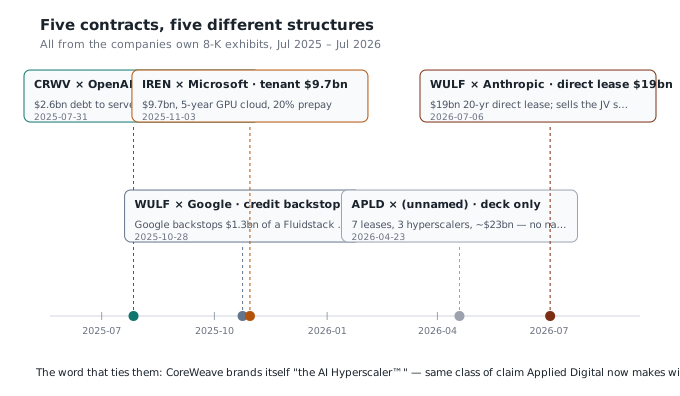
Laid out as transactions rather than counts, the same set turns into a taxonomy of how AI infrastructure gets financed and contracted: direct tenant (IREN-Microsoft, prepaid), vendor financing behind a customer (CoreWeave-OpenAI, where the debt facility and the customer agreement move together), credit backstop of a third-party lease (Google-Fluidstack-TeraWulf, three-way), direct long-lease with an AI lab (Anthropic-TeraWulf, 20 years), and anonymous hyperscaler leases (Applied Digital's seven). Five structures in twelve months, all filed under Item 1.01 "Entry into a Material Definitive Agreement" - a line item that barely existed in mining companies' filings in 2023.
The credit angle is the genuinely new instrument. A hyperscaler backstopping a lease it does not occupy (Google's $1.3bn) means the giant is underwriting the neocloud's customer (Fluidstack) to secure capacity it may take over - optionality priced as insurance. Watch for this shape to repeat: the next Anthropic-scale lab does not sign a lease, it signs a backstop and lets a developer carry the concrete.
What this census cannot tell you
- Counterparty identity where companies hide it. Applied Digital's two unnamed hyperscalers are, at the time of writing, genuinely unknown from filings; press reporting names candidates but we do not launder press through our register.
- Revenue realized vs contracted. Every dollar figure above is expected contracted revenue over the initial term, from the company's own release - not recognized income.
- Completeness of relationships. Absence from the matrix is not absence of commerce: Amazon appears once in IREN's documents but leases from many. We measure the filing habit, not the full deal.
- Deal health after signing. CoreWeave-OpenAI, IREN-Microsoft, TeraWulf-Anthropic: none of these agreements has yet reached a full billing cycle reported in this window.
What is a neocloud?
Who has a real contract with Microsoft, IREN or CoreWeave?
Why does TeraWulf mention Google so much if Google is not its customer?
What did Applied Digital actually sign?
Does more co-mention volume mean a stronger partnership?
- Population: SEC filings 2024-01-01 to 2026-11-17, via EDGAR full-text search (agentdata pull of 2026-11-17). Pair counts include only documents filed by the named neocloud itself (company-field match, word-boundary regex); fund/ETF forms (NPORT, 13F, N-CSR, 497) are excluded - the IREN-Oracle cell drops from 6 to 1 and CoreWeave-AWS from 20 to 0 under this rule.
- Cell counts are file-level: one 8-K naming both parties counts once for that pair. Some 8-Ks bundle exhibits; we counted the filing, not each exhibit.
- Roles are claimed only for 6 cells where the underlying document was read verbatim (IREN-Microsoft 8-K 2025-11-03; TeraWulf 8-K 2025-10-28 and 2026-07-06; CoreWeave 8-K 2025-07-31; Applied Digital investor presentation 8-K ex-99.2 2026-04-23; plus IREN-Nvidia vendor language from the first). All other cells report counts without role claims.
- Word-boundary filtering matters: a substring match on "iren" also hits the Siren ETF Trust (10 of 20 documents in one unfiltered cell).
- The neocloud term census (0/0/87/435 by 2023/2024/2025/2026-to-date) uses the same forms-inclusive search on the quoted term; it is category context, not a company claim.
- Every dollar figure is a company-stated expected contracted value from its own release (e.g. "$19 billion of contracted revenue over the initial lease term" - TeraWulf, July 6, 2026), not recognized revenue.
- No investment advice; no view on share prices or deal quality.
Every number here is a document link away. Sign up free to pull the 8-Ks behind any company pair, or put a watch on a name - the next Item 1.01 lands in your query the day it is filed.