 Dicaria
Food recalls run hot: half of them are the most serious kind
Drug recalls in the same FDA file are 5.5% Class I. Food recalls from the same months are half that way. The reason is not sloppier industry — it is that the most common food failures cannot safely reach the table.
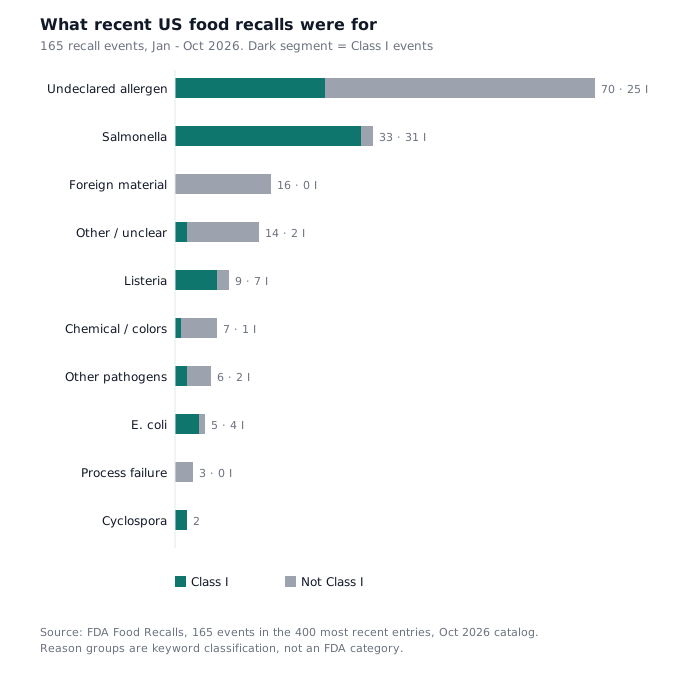
Of the 400 most recent FDA food recall entries (165 separate events, January – October 2026), 206 rows (51.5%) are Class I — the tier the FDA reserves for a reasonable probability of serious health consequences or death. In the drug file from the same months: 5.5%. The mix explains it — allergens are the largest group (42.4% of events) yet escalate least (35.7% Class I); the four pathogens are 30% of events but 59% of the Class I ones.
Why does food escalate where drugs don't?
Start from what Class I means: the FDA's definition is a reasonable probability of serious adverse health consequences or death from normal use. A tablet that is 12% under-potent is a real defect and a Class II event. Lettuce carrying salmonella is not a deviation from a spec — it is the hazard itself, and eating it is ordinary behavior.
That asymmetry is structural, not a judgment on who manufactures better. A drug has a dose, a label, a batch record and a stability window; most recalls catch it before harm, inside tolerance. Ready-to-eat food has none of those buffers against a pathogen: there is no "slightly contaminated" serving, and no further step between the product and the person.
In the sample, the four pathogen labels (salmonella, listeria, E. coli, cyclospora) account for 49 of 165 events but 44 of the 75 Class I events (58.7%). Salmonella alone: 33 events, 31 Class I (93.9%). When the reason names a pathogen, the class is nearly decided.
70 of 165 events are allergens — and they escalate least
Undeclared allergen is the most common food recall reason: 70 of 165 events (42.4%). It is also the group with the mildest escalation rate among the large ones — 35.7% Class I, versus 77.8–93.9% for the pathogens in the large groups (cyclospora: 2 of 2, too few to rank).
The split makes sense when you read the reasons. "May contain undeclared milk" describes a labeling and packaging failure: most consumers eating it are perfectly safe, and the class tracks the size of the exposed population that is not. Within the allergen rows, milk (31), wheat (23) and sesame (14) lead the named substances.
A useful way to hold both numbers at once: allergens generate the most recalls; pathogens generate the most serious recalls. Any ranking of "top food recall reason" that does not state which axis it ranks on is comparing nothing.
400 rows, 165 events: which unit do you mean?
One data-reading trap this sample makes visible. The 400 entries carry only 165 distinct event IDs: the file's row is one recall number for one product (or one package size), and one incident can fan out across dozens of rows. The largest single event in the window — a candy product with undeclared color additives — spreads over 61 rows, and it is Class II.
Consequence: percentage claims change depending on the unit. Allergens are 44.0% of rows but 42.4% of events; Class I is 51.5% of rows and 45.5% of events. Neither unit is wrong; a headline that does not say which one is careless. This article quotes event shares for "how common" and row shares only for the raw file shape. If you need the other unit, rerun the split on your own window — the endpoint behind every number on this page is included in the free sign-up.
How far apart are the ten reason groups?
| Reason group | Events | Share of events | Class I within group |
|---|---|---|---|
| Undeclared allergen | 70 | 42.4% | 25 (35.7%) |
| Salmonella | 33 | 20.0% | 31 (93.9%) |
| Foreign material (glass, metal, plastic, bone) | 16 | 9.7% | 0 (0.0%) |
| Other / unclear | 14 | 8.5% | 2 (14.3%) |
| Listeria | 9 | 5.5% | 7 (77.8%) |
| Chemical (color additives, lead, adulterants) | 7 | 4.2% | 1 (14.3%) |
| Other pathogens / spoilage | 6 | 3.6% | 2 (33.3%) |
| E. coli | 5 | 3.0% | 4 (80.0%) |
| Process failure (pasteurization, 5-log) | 3 | 1.8% | 0 (0.0%) |
| Cyclospora | 2 | 1.2% | 2 (both) |
Groups are a keyword classification of the free-text reason field (first match wins) — our reading of the FDA's own words, not an FDA category. Foreign material landing at 0% Class I for 16 events is the pattern you would expect: a piece of plastic in a bag of salad is a Class II event nearly every time.
What this data cannot answer
- Illnesses and outbreaks. The file records recall actions, not who got sick. A Class I salmonella recall with zero reported illnesses and one with fifty look the same here.
- Recall rate per product. There is no denominator — this says nothing about how much food is safe.
- Whether severity is rising. The window is ten months of 2026 with an August produce spike (159 of 400 rows); no year-over-year claim is possible.
- Root cause. The reason text names the hazard, not where it entered the line.
Frequently asked questions
What is a Class I food recall?
What is the most common reason foods are recalled?
Are food recalls more serious than drug recalls?
Does a Class I recall mean I already ate something dangerous?
- Data pull: 2026-11-06 (agentdata SDK).
- Source: FDA Food Recalls endpoint (agentdata SDK), retrieved 2026-11-06; the 400 most recent entries by the file's own ordering. recalled_on runs 2026-01-09 to 2026-10-07. Status: 348 of 400 rows Ongoing.
- Two units, always stated: rows (400; one recall number per product/package) and events (165; distinct event_id, the incident). Percentage differences between them are reported, not averaged away.
- Reason groups: keyword classification of the free-text reason field, first match wins; our grouping, not an FDA category. Class labels come straight from the classification field; definitions quoted from FDA's recall background page.
- Pathogen aggregates (49 events / 44 Class I) and escalation shares are derived from the sample.
- The firm field exists in the data and is not used in this article. One 61-row allergen/color event was identified only by event_id for the unit explanation.
This page came from one endpoint: FDA food recalls, pulled for a window, grouped by reason and class — at event level and row level, each group's Class I rate, the recall number on every line. Sign up free, get the key and an MCP config, and ask your AI agent for the same split with your own window and filters.
A free allowance is included at sign-up — no email application. Register so your runs are saved, repeatable, and citable by query.