 Dicaria
America's drug shortage list is not a crisis — it's infrastructure
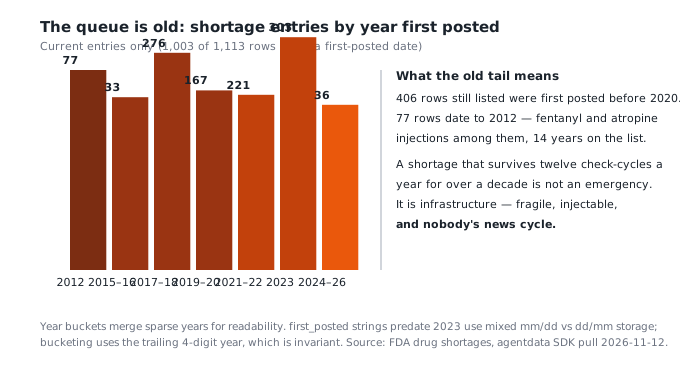
The FDA shortage list currently carries 68 drugs across 1,113 tracked presentations. Nearly three-quarters are injectables. Fentanyl and atropine injections have been on the list since January 2012. A shortage that survives 14 years of weekly checks is not an emergency — it is how the supply works now.
The FDA shortage list currently tracks 68 drugs across 1,113 presentations — and 74% of them are injectables: lidocaine 65 rows, bupivacaine 57, dexmedetomidine 56, carboplatin 29. ADHD medications are fragmented across 219 rows and 24 manufacturers. The oldest entries — fentanyl and atropine injections — have been listed since January 2012. Eight hundred fourteen of the rows carry a "reverified" stamp from this cycle: the list is checked week after week, which makes it a standing condition, not a crisis.
To look up a specific presentation, rerun the registry query yourself — the full list moves weekly.
The list measures fragility, not emergencies
The FDA drug shortage registry logs every presentation — drug plus strength plus form — that a manufacturer reports as constrained, plus every one FDA verifies independently. The current list holds 1,113 rows covering 68 distinct drugs.
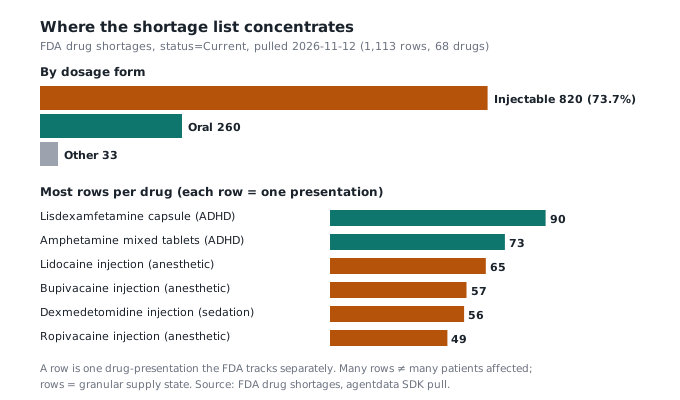
A row is not a scandal. Each row is one presentation the FDA re-checks on a schedule — 814 of the current rows carry a reverified stamp from the latest cycle. What the list measures is which parts of the supply are structurally fragile, and the answer is pointed: injectable sterile drugs, where manufacturing is harder, margins are thinner, and one failed quality lot removes supply for months.
By dosage form: 820 injectable rows (73.7%), 260 oral, 33 other. Sterile injectables were also the failure mode of the recall side of this series — the same manufacturing difficulty that makes sterile drugs prone to contamination recalls makes them prone to shortages, because a quality failure and a supply gap are the same event seen from two directions.
Find your drug: the 4 groups
If you are here for a specific drug, the current list clusters into four groups:
Surgery and anesthesia (375 rows, 10 drugs). Lidocaine 65 rows, bupivacaine 57, dexmedetomidine 56, ropivacaine 49, midazolam 30, hydromorphone 26, morphine 24, fentanyl 20, etomidate 18, remifentanil 9. Hospital pharmacy teams have been managing this group continuously since 2017.
ADHD (219 rows, 5 drugs, 24 manufacturers). Lisdexamfetamine 108 rows — capsules 90, chewables 18 — mixed amphetamine salts 73, methylphenidate extended-release 38 plus film 4. This is the most fragmented group on the list — and the most confusing, because availability differs by strength and manufacturer.
Chemotherapy (about 65 rows). Carboplatin 29 rows — 12 unavailable, 8 limited, 9 available. Methotrexate injection 15, ifosfamide 8, azacitidine 9. Cisplatin, the headline shortage of 2023, is no longer on the list — recovered, not forgotten.
Emergency and critical care (65 rows). Atropine 17, plus epinephrine combination products. Naloxone is not currently listed.
The full list — every drug, row count and availability state (A=available, U=unavailable, L=limited):
| drug (68 on the current list) | Rows | A/U/L | Form |
|---|---|---|---|
| lisdexamfetamine capsule | 90 | 57/0/33 | oral |
| mixed amphetamine salts tablet | 73 | 44/19/10 | oral |
| lidocaine HCl injection | 65 | 43/21/1 | inj |
| bupivacaine HCl injection | 57 | 43/9/5 | inj |
| dexmedetomidine HCl injection | 56 | 45/10/1 | inj |
| ropivacaine HCl injection | 49 | 33/13/3 | inj |
| dextrose 5% injection | 36 | 25/2/9 | inj |
| methylphenidate HCl (extended) | 34 | 16/6/12 | oral |
| midazolam HCl injection | 30 | 18/9/3 | inj |
| carboplatin injection | 29 | 9/12/8 | inj |
| furosemide injection | 27 | 16/11/0 | inj |
| hydromorphone HCl injection | 26 | 15/8/3 | inj |
| bupivacaine Hydrochloride, epinephrine Bitartrate injection | 26 | 16/9/1 | inj |
| rocuronium injection | 26 | 23/2/1 | inj |
| ketorolac injection | 25 | 12/12/1 | inj |
| morphine Sulfate injection | 24 | 16/6/2 | inj |
| methylprednisolone acetate injection | 23 | 7/7/9 | inj |
| epinephrine + Lidocaine HCl injection | 22 | 9/7/6 | inj |
| fentanyl injection | 20 | 12/5/3 | inj |
| dexamethasone injection | 19 | 15/4/0 | inj |
| etomidate injection | 18 | 13/5/0 | inj |
| lisdexamfetamine (extended) | 18 | 18/0/0 | oral |
| atropine Sulfate injection | 17 | 10/6/1 | inj |
| clindamycin injection | 17 | 10/4/3 | inj |
| quinapril HCl tablet | 16 | 4/12/0 | oral |
| amino-acid (TPN) injection | 16 | 13/3/0 | inj |
| sodium acetate injection | 15 | 13/1/1 | inj |
| methotrexate Sodium injection | 15 | 9/4/2 | inj |
| dextrose 10% injection | 13 | 6/1/6 | inj |
| sterile water injection | 13 | 9/3/1 | inj |
| dopamine HCl injection | 11 | 7/3/1 | inj |
| sodium bicarbonate injection | 11 | 7/1/3 | inj |
| lorazepam injection | 11 | 2/4/5 | inj |
| dobutamine HCl injection | 10 | 9/1/0 | inj |
| promethazine HCl injection | 10 | 5/4/0 | inj |
| rifampin capsule | 9 | 5/4/0 | oral |
| remifentanil HCl injection | 9 | 5/4/0 | inj |
| sterile water irrigation | 9 | 4/4/1 | other |
| azacitidine injection | 9 | 4/4/1 | inj |
| liraglutide injection | 9 | 6/0/3 | inj |
| heparin Sodium injection | 8 | 3/3/2 | inj |
| ifosfamide injection | 8 | 5/2/1 | inj |
| quinapril/HCTZ tablet | 6 | 3/3/0 | oral |
| cromolyn Sodium concentrate | 6 | 4/0/2 | other |
| meperidine HCl injection | 6 | 6/0/0 | inj |
| cefotaxime Sodium powder | 6 | 2/4/0 | other |
| flurazepam HCl capsule | 6 | 4/2/0 | oral |
| dextrose 70% injection | 4 | 4/0/0 | inj |
| metronidazole injection | 4 | 1/1/2 | inj |
| sufentanil injection | 4 | 0/3/1 | inj |
| penicillin G benzathine injection | 4 | 1/1/2 | inj |
| methylphenidate (extended) | 4 | 4/0/0 | oral |
| riluzole oral susp | 4 | 3/1/0 | oral |
| desmopressin spray | 4 | 0/3/1 | other |
| rifampin injection | 3 | 0/2/1 | inj |
| tc-99m PYP kit injection | 3 | 0/2/1 | inj |
| dextrose 50% injection | 3 | 0/1/2 | inj |
| furosemide Oral Solution | 3 | 3/0/0 | oral |
| valproate Sodium injection | 2 | 1/1/0 | inj |
| propranolol HCl injection | 2 | 0/2/0 | inj |
| streptozocin powder | 2 | 1/1/0 | other |
| hydroxocobalamin injection | 2 | 0/1/1 | inj |
| echothiophate iodide ophthalmic | 1 | 1/0/0 | other |
| bacitracin ophthalmic | 1 | 0/1/0 | other |
| pentostatin injection | 1 | 0/1/0 | inj |
| conivaptan HCl injection | 1 | 0/1/0 | inj |
| triamcinolone hexacetonide injection | 1 | 1/0/0 | inj |
| isocarboxazid tablet | 1 | 0/0/1 | oral |
The groups above are where the rows concentrate; the table is where a specific name is. If your drug is not on it, it is not on the FDA current list as of 2026-11-12.
The Available-rows problem: listed does not mean unfillable
Seventy-five of the lisdexamfetamine rows are marked Available — yet they sit on the shortage list. That is not a contradiction; it is the list's actual definition. A drug stays listed while its supply is judged fragile: one manufacturer still out, demand shifted to fewer suppliers, or the FDA still verifying recovery. On this list means "watch this presentation," not "you cannot fill this prescription." The patient-facing version of that is: the same drug name can be fillable at one pharmacy and unfillable at the next, because they buy from different suppliers.
Fourteen years on the list: fentanyl and atropine
The 1,003 current rows that carry a first-posted date span 2012 to 2026. The 2012 entries — 77 rows — include fentanyl citrate injection and atropine sulfate injection, both still listed, fourteen years later. 46% of the list predates 2020. These entries survive roughly fifty re-verification cycles a year, every year, without resolving.
That is why "shortage" is the wrong mental model. A shortage ends. This list behaves like a chronic condition: entries resolve slowly, new ones arrive, and the mix drifts toward products where few manufacturers hold sterile-fill capacity and margins do not attract new entrants. The list's own reason field mostly declines to explain: 678 of 1,113 rows (61%) cite no reason at all. Where reasons exist, demand increase leads (126), then active-ingredient shortage (61), manufacturing discontinuation (46), shipping delay (21), GMP-compliance requirements (14).
What this list cannot tell you
- When your drug recovers. Almost no row carries an ETA; the list states current supply state, not forecasts.
- Why, in most cases. The empty reason field is an upstream data gap, not a mystery to solve.
- Prices. The list tracks availability, not what a scarce drug costs once it is scarce.
- Anything outside the US registry. Other regulators run their own lists; a drug can be listed here and unlisted elsewhere.
Which drugs are currently in shortage in the US?
Is fentanyl still in shortage?
Why is my ADHD medication hard to fill?
How long does a drug shortage last?
Does a drug on the shortage list mean pharmacies can't fill it?
- Source: FDA drug shortage registry via the agentdata SDK, pulled 2026-11-12; status=Current 1,113 rows covering 68 distinct drug names, plus 59 resolved and 426 discontinued rows for context.
- A row is one drug-presentation (name + strength + form). Row counts overstate distinct drugs; 68 is the distinct-name count.
- Dosage-form split (injectable 820 / oral 260 / other 33) uses a regex over the dosage-form and drug-name fields; the grouping is ours, not FDA's.
- availability as pulled: Available 680, Unavailable 276, Limited Availability 154 (plus two spelling variants and one row carrying a June-2027 recovery estimate, which we did not normalize).
- shortage_reason is empty on 678 of 1,113 rows (61%); reason counts above are of populated fields only.
- first_posted strings mix mm/dd/yyyy and dd/mm/yyyy across eras; year bucketing uses the trailing four digits, which is invariant.
- This article describes registry data, not clinical guidance; for patient-facing advice the FDA's shortage FAQ is the canonical reference.
The full registry — every presentation, availability flag and reason field — is one query. Sign up free and look up the drug you fill, dispense or buy, then re-check it next month: the list moves weekly.