 Dicaria
A tablet problem and an injection problem are not the same problem
People read recalls as a story about firms or molecules. In a sample of 600 recent FDA drug recalls, the dosage form sorts the failures into two different worlds — and decides how far one can escalate.
In the 600 most recent FDA drug recalls (October 2025 – October 2026), the dosage form splits the failure book in two. Of 283 sterile-route entries, 50.5% are sterility failures and 20.8% particles. Of the other 317, the top reasons are manufacturing (23.3%), potency (19.9%) and impurities (16.4%). The form also caps how serious a failure can get: 7.8% of sterile-route recalls are Class I, versus 3.5% of the rest.
What people assume about recalls
The usual reading of a recall list is a story about who made the drug. One firm appears five times this quarter, so the firm is the finding. Or the molecule is: this active ingredient must be the risky one.
Neither survives the split. Take the same 600 entries, ignore the firm and the molecule, and sort by dosage form instead — injectables, infusions, eye drops, solutions versus everything swallowed or applied. Two different failure books fall out, with almost no overlap in their first three reasons. The firm field is not used anywhere in this article; the split reproduces without it.
The same 600 entries, sorted by form
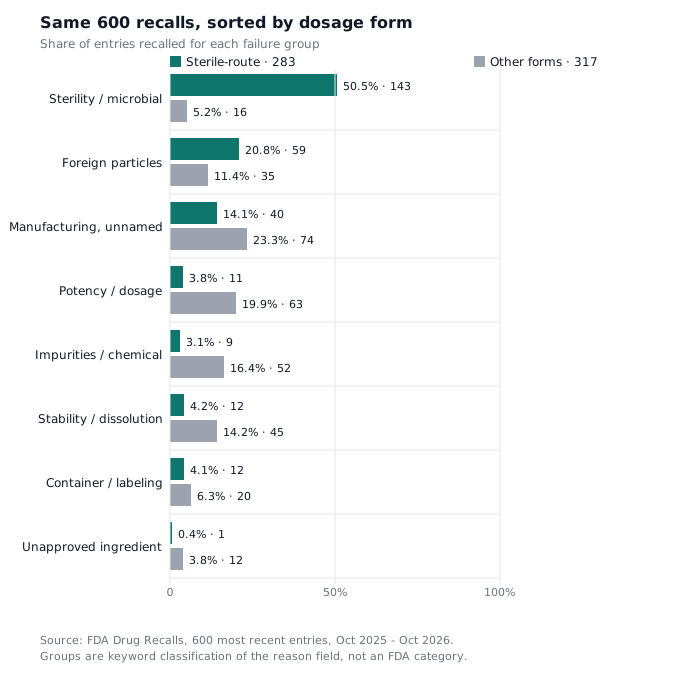
| Failure group | Sterile-route (n=283) | Other forms (n=317) |
|---|---|---|
| Sterility / microbial | 143 (50.5%) | 16 (5.2%) |
| Foreign particles | 59 (20.8%) | 35 (11.4%) |
| Manufacturing, defect unnamed | 40 (14.1%) | 74 (23.3%) |
| Potency / dosage accuracy | 11 (3.8%) | 63 (19.9%) |
| Impurities / chemical | 9 (3.1%) | 52 (16.4%) |
| Stability / dissolution | 12 (4.2%) | 45 (14.2%) |
| Container / labeling | 12 (4.1%) | 20 (6.3%) |
| Unapproved / undeclared | 1 (0.4%) | 12 (3.8%) |
Sterile-route failures are barrier failures: something got in that must not be in (a microbe, a glass fragment). Other-form failures are dose failures: the wrong amount of the right thing, or an impurity above its limit. A sterile product does not need to be potent — it needs to be clean. A tablet is judged on chemistry: does it deliver the label amount, within spec, to expiry.
The reason groups are our keyword classification of the free-text reason field — the same rules used in two companion articles on recall reasons and Class I recalls; the counts are derived from one 600-row sample, not from FDA categories.
The form also decides the ceiling on severity
Risk class and reason are different columns, but they stop being independent once you sort by form.
- Class I rate: 7.8% of sterile-route entries (22 of 283), 3.5% of the rest (11 of 317). FDA defines Class I as a reasonable probability of serious harm or death.
- The sharpest case is particles. A particle found in a solution that enters a vein: 14 of 59 sterile-route particle recalls are Class I (23.7%). A particle in a tablet or cream: 1 of 35 (2.9%). Same defect word, eight-fold difference in what it can do.
- The 11 other-form Class I entries are a different story again: four are undeclared ingredients (sildenafil, tadalafil, meloxicam found in products that never declared them), four are contamination of products that touch vulnerable tissue, one each potency, impurity and particle.
The reading is not "injectables are more dangerous". It is that the dosage form sets the maximum severity a given defect can reach. Glass in saline can embolize; glass in a chewable tablet mostly cannot. Which is why the identical reason text lands in different classes.
Where the rule breaks, and what the real rule is
Sixteen sterility failures happen outside injectables. Reading them is what turns a slogan into a rule. They are eye gels and lubricant drops, nasal sprays and swabs, wound-care gel, saline irrigations in 3,000 mL bags, alcohol prep pads, benzoyl peroxide wash.
None is a needle. All share one property: the product bypasses the skin barrier or touches tissue where microbes are not tolerated. That is the actual rule. "Injectable" is the easy proxy for it, and mostly correct — 143 of 159 sterility rows in the sample are the injectable/liquid class — but the exceptions are not random. They are the other ways the barrier gets crossed.
For anyone turning this into a watchlist: filter on the barrier property (inject, irrigate, ophthalmic, nasal, wound), not on the word "injection".
What we tested and dropped
- Does distribution differ by form? No — 94.7% of sterile-route and 94.3% of other-form entries say nationwide. Too close to a finding; not claimed.
- Does any firm cluster the pattern? The firm field was deliberately not used. A per-firm version of this table would name companies; the article makes its point without them.
- Is one form's rate "the recall rate" of that form? No. There is no market-volume denominator in this file — 283 sterile-route recalls is a share of recalls, not a risk of being recalled.
What this data cannot answer
- Root cause. The reason field names what was found, not where it entered the process.
- Whether the form mix mirrors the market. It reflects which forms get caught and recalled, in one period.
- Whether Class I escalation is rising. The sample spans about twelve months (592 of 600 dated 2026).
- Patient outcomes. There is no injury field; Class I is a probability statement.
Frequently asked questions
Which drugs are recalled most often?
Why are injections recalled more than pills?
How serious are injectable recalls compared to tablet recalls?
Are compounded medications part of this pattern?
- Source: FDA Drug Recalls endpoint (agentdata SDK), 600 most recent entries by report date, 2025-10-08 to 2026-10-13; 592 dated 2026. Not a random sample of the ~18,000-entry file.
- Form split: keyword rule on the product description (inject / vial / infusion / syringe / ophthalmic / drop / solution / suspension); group named "sterile-route" after the counterexamples in section four.
- Reason groups: keyword classification of the free-text reason field, first match wins — the same rules as the two recalls articles this one links to. All shares are derived from the 600-row sample.
- Class I/II/III: taken from the classification field; definitions quoted from FDA's Recalls Background and Definitions page.
- The recalling-firm field exists in the data and is not used in this article.
Install in one sentence and ask your AI agent: the 600 most recent FDA drug recalls, grouped by dosage form and risk class, each row carrying its recall number and the verbatim reason.
Form, reason and class are fields, not interpretations — every split above is recomputable on demand.