 Dicaria
A banned perfume ingredient caused a third of Europe's 2025 danger alerts
Of the 4,704 dangerous-product alerts the EU filed in 2025, 1,487 (31.6%) name a single banned fragrance: BMHCA, sold as Lilial, prohibited in cosmetics since March 2022. Nearly all of it is one country's own stock sweep: 97.8% of Italian-origin alerts were filed by Italy itself. The rest of the year's chemical failures look different — mercury in lightening creams from Pakistan, hydroquinone from West Africa.
The EU's Safety Gate filed 4,704 dangerous-product alerts in calendar 2025. 1,487 (31.6%) name one substance: BMHCA, the fragrance sold as Lilial, banned in cosmetics since 1 March 2022 for reproductive toxicity. 579 of 592 Italian-origin alerts (97.8%) were filed by Italy itself — a domestic sweep of pre-ban stock. Germany-origin: 0 of 136 self-filed; France-origin: 1 of 118. The monthly swing (231 in January, 18 in September) tracks inspectorate calendars, not new contamination.
To check a specific product, run the Safety Gate query yourself — every 2025 alert, substance named and all, is one query away.
The molecule behind 1,487 alerts
BMHCA (butylphenyl methylpropional, CAS 80-54-6, trade name Lilial) smells like lily of the valley. It was one of the workhorses of mass-market fragrance. In 2019 the EU's Scientific Committee on Consumer Safety concluded it could not be considered safe in cosmetics; ECHA classified it as reproductive toxicant category 1B (animal evidence of testicular toxicity and effects on fertility). The Commission moved it from the restricted list to the prohibited list (Annex II of the Cosmetics Regulation) with effect from 1 March 2022.
Four years later, the product supply chain is still feeding it into the alert system. Our count over the 2025 weekly reports (pulled 2026-11-12, all 52 reports, 4,704 alerts): every alert whose risk text matches the substance name — 1,487 of them — names BMHCA explicitly (the match includes the INCI spelling and the chemical name; 1,486 carry both). It is 31.6% of everything Europe flagged that year: more than the toy category in total, more than electrical appliances and motor vehicles combined.
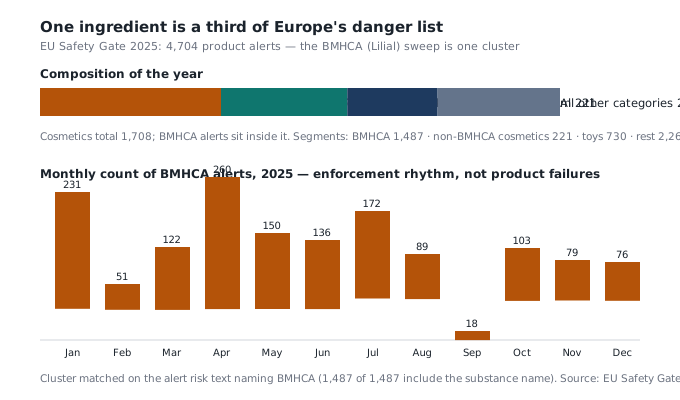
Nearly all are perfumery: eau de toilette and cologne 408, perfume 298, hair products 205, creams 106, deodorants 89, shower gels 58 (remainder 323 other). Almost the entire cluster (1,485 of 1,487) is marked Serious risk — the system's top tier — because a CMR-1B substance in a leave-on product is treated as inherently serious regardless of dose.
Italy's 97.8%: the top origin is a domestic audit
Here is the part the raw league table hides. In the BMHCA cluster, Italy appears at the top of country-of-origin counts (592). But 579 of those 592 alerts were filed by Italian authorities themselves. Compare: of the 136 German-origin alerts, 0 were filed by Germany; of 118 French-origin, 1; of 94 Spanish-origin, 0 — those were caught by other member states' inspectors.
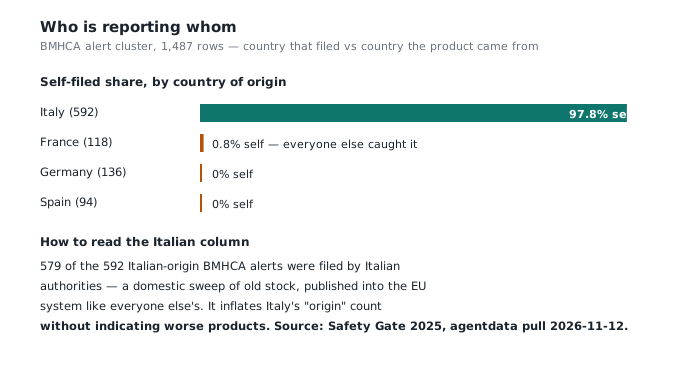
The difference is what a market-surveillance system publishes. Italy ran a domestic sweep of old stock — warehouses, drugstore chains, online listings — and every removed item entered the EU-wide system the same way a border rejection does. That inflates Italy's "origin" count while actually evidencing the most diligent enforcement in the union: 26% of all 2025 alerts across all categories were filed by Italy. German and French products showing up in other countries' alerts tell you where the stock was sold, not who inspected it.
Same-product logic applies when reading the rest of the origin table. Lilial-heavy China-origin alerts are 35 of 1,487 (2.4%) — the Chinese share of this year's danger list lives in toys and appliances, not in this fragrance cluster.
What is actually dangerous, and how it differs
Three chemical failure clusters ran through 2025 cosmetics alerts, and they are three different problems:
Lilial (1,487 alerts) is a compliance gap: legitimate brands' old batches, reformulated labels on un-recalled stock. It is the one whose substance name is usually printed on the ingredient list — the label is the evidence.
Mercury in skin-lightening creams (18 alerts) is an illegal-active problem: the origin labels read Pakistan 12, Thailand 2, and the product names say "lightening". Mercury is banned outright; it shows up in unbranded or mail-order cosmetics sold through marketplaces.
Hydroquinone (37 alerts) concentrates on West African-origin lightening products (Côte d'Ivoire 7, Congo 5, Cameroon 4, Ghana 4 in our count; a large "Unknown" bucket). Hydroquinone is a prescription-only depigmenting agent in the EU; over-the-counter use carries ochronosis risk.
The three clusters share almost no supply chain. Reading "31.6% Lilial + a lightening-cream tail" as one story — "cosmetics are toxic" — misses that the first is an enforcement sweep of a dead molecule and the others are live black-market actives.
What this data cannot tell you
- Exposure. An alert is a lab finding on a sample plus an ordered measure, not a dose assessment; there is no usage or harm field in the file.
- Recall completeness. The measures text says ban/withdraw/recall; nothing says how many units actually moved.
- Who failed. Brand and manufacturer appear as record facts, but alert counts per brand track inspection attention; we keep brands out of headlines.
- 2026 trends. This is calendar 2025 — the only year complete enough to rank months.
What is Lilial and why was it banned?
How many EU safety alerts are about Lilial?
Why is Italy at the top of the origin list?
Is a product bought in 2025 dangerous if Lilial is on the label?
Wasn't it banned in 2022 — why still alerts in 2025?
- Source: EU Safety Gate weekly reports, all 52 of calendar 2025, pulled 2026-11-12 (4,704 alert rows, zero failures). One row = one product alert.
- BMHCA cluster: rows whose risk description matches /BMHCA|Lyral|2-(4-tert/i. Verified: all 1,487 matched rows contain "BMHCA" explicitly; "Lyral" matches 0 rows (Lyral/HICC, the 2021 fragrance ban, is a different substance — 43 alerts, kept out of this cluster).
- Self-filed share: comparing notifying_country to country_of_origin within the cluster. Italy 579/592; France 1/118; Germany 0/136; Spain 0/94.
- Monthly spread computed from each alert's weekly-report publication date.
- Mercury/hydroquinone counts are keyword clusters on the cosmetics risk field (18 and 37); the lightening-product identification is ours, not the Commission's.
- The Commission's 2025 annual report cites 4,671 alerts; our complete pull of the weekly reports yields 4,704. The difference (~33) likely reflects post-publication corrections or dedup in the report pipeline; the article uses the raw weekly-report population.
- Alerts are surveillance actions with ordered measures; the file has no injury, dose, or exposure fields.
Every 2025 alert — substance, brand, barcode, batch, measure — is one query. Sign up free and look up your own products, or the origin-and-filer table for any country.