 Dicaria
Microsoft/OpenAI: the UK reviewed five AI deals as mergers — none blocked
Between December 2023 and April 2025 the UK competition regulator opened merger inquiries into five AI partnerships that were not acquisitions: Microsoft/OpenAI, Microsoft/Mistral, Amazon/Anthropic, Google/Anthropic, Microsoft/Inflection. The register titles say 'partnership merger inquiry'. Every case ended the same way — no control was acquired — but the reviews took 16, 5, 5 and under 1 months, and the pattern is now the template.
Between December 2023 and April 2025 the UK CMA ran merger inquiries into five AI partnerships that were not acquisitions (Microsoft/OpenAI, Microsoft/Mistral, Amazon/Anthropic, Google/Anthropic, Microsoft/Inflection). None was blocked. Three exited as not qualifying — in under a month, 5 months, and 16 months — one cleared in 5. Every case asked merger law's oldest question: was control acquired? Every answer: no. What changed is that minority stakes in AI labs are now merger-review events at all.
To pull any of these case files — timeline, decisions, attachments — query the CMA register yourself; the five AI cases are one filter away.
What the register says, in its own words
The UK merger regime (Enterprise Act 2002, part 3) reviews acquisitions of control: material influence over another company's policy counts, and so does outright ownership. A licensing deal or a supplier contract is not reviewable no matter how much money moves.
The CMA case register is the most unglamorous source in competition law — a flat list with a change history per case. But read its titles and the regulatory event of 2024 is visible in the naming convention itself: "Microsoft / OpenAI partnership merger inquiry", "Amazon / Anthropic partnership merger inquiry". Not "market study", not "case review". Merger inquiry — the heaviest tool in the kit, pointed at investments that bought minority stakes and board-adjacent access, not companies.
We pulled the full register (1,261 cases with "merger inquiry" in the title, 2003–2026; pulled 2026-11-16) and the per-case change histories for the five AI rows. Here is everything the archive records, case by case.
5 cases, one exit path
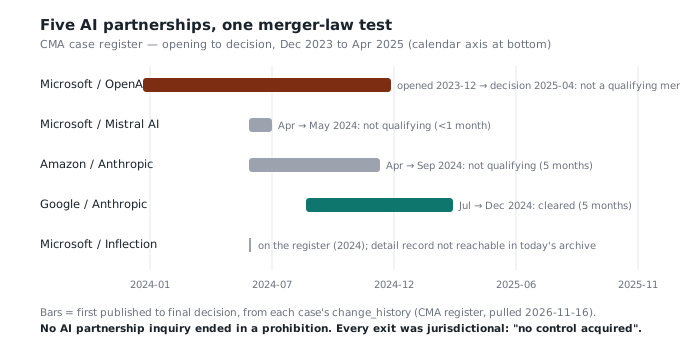
Microsoft / OpenAI (opened 8 Dec 2023 — decision 5 Mar 2025, full text 15 Apr). The longest of the five: ~16 months. The CMA's finding, as reported from its statement: Microsoft had significant influence over OpenAI as early as 2019 — but did not acquire de facto control, so no qualifying merger situation arose; no intervention. The CMA added a sentence worth keeping: the conclusion "is not a finding that their operations do not raise competition concerns." The merger test answered a narrower question than the one the public was asking.
Microsoft / Mistral AI (opened April 2024 — closed 17 May 2024). Under one month. "Found not to qualify" — a €20M minority investment, no influence over policy. The fastest case shows the test at its thinnest.
Amazon / Anthropic (opened 24 Apr 2024 — "found not to qualify" 27 Sep, full decision 17 Oct). Five months for an $4B (later $8B) investment: the CMA examined whether Amazon's cash, compute and commercial rights crossed into control, and concluded they did not.
Google (Alphabet) / Anthropic (opened 30 Jul 2024 — Phase 1 summary 19 Nov, full decision 24 Dec). Five months, cleared. $2B with no board seat, no voting rights, no supply exclusivity.
Microsoft / Inflection (on the register, 2024). The fifth case exists in the index (title search confirms it) but its detail record no longer resolves at today's archive path — we list it and stop there; whatever its exit, we cannot document it from this register, so it carries no claim in this article.
Four documented exits, one shape: jurisdictional. Nobody was blocked because nobody was found to control.
Why the same deals got merger review in 2024 but not in 2014
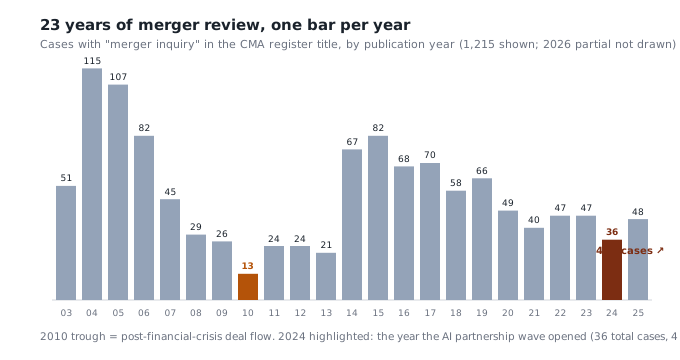
The register spans the whole post-2003 history: 115 inquiries in 2004, a post-financial-crisis trough of 13 in 2010, recovery to 67–82 by 2014–15, 36 in 2024. Against 1,215 published cases in 2003–2025, the five AI rows are 0.4%. The volume is trivial; the concentration is not. Four of them opened inside an eight-month window (Apr–Nov 2024) — against 2024's entire caseload of 36 that is roughly one in nine of that year's merger inquiries aimed at AI partnerships. No sector got that treatment in the previous two decades.
The mechanism sits in the law's oldest question. Historically, big-company investments in startups were invisible to merger control: 5% stakes, no board seats, commercial agreements — under the threshold. AI labs inverted the package: the money was minority, but the compute dependency, IP licenses and information access looked like the effects of control without its forms. The CMA's answer was not to rewrite the test — all four documented cases passed it unchanged — but to run the full inquiry procedure against partnerships, which is itself a signal: any future Microsoft-scale AI investment now enters the register by default.
Read the OpenAI case timeline again with that in mind. Sixteen months, a full-text decision, a jurisdictional exit — and the regulator's parting note that competition concerns were not evaluated. The merger door stays shut, but the building now knows where the door is. (US and EU regulators ran their own parallel processes on parts of these deals; this article describes the UK register — the file we can actually pull.)
What this register cannot tell you
- Why, beyond the legal test. The change histories record what was published when, not the internal deliberations.
- The US or EU outcomes — separate files, separate law. The UK cases ended 'no control'; other jurisdictions reached other questions.
- Whether structure was designed around the test. The archive shows stakes that stayed below the control line; intent is not a field.
- Deal value. The register does not carry transaction amounts; the figures we cite (Amazon/Anthropic, Google/Anthropic) come from the companies' own disclosures and are labeled as such.
Did the UK block any AI partnership deals?
Why are AI investments being reviewed as mergers at all?
How long do these reviews take?
What did the CMA actually find about Microsoft and OpenAI?
Does this mean AI megadeals can bypass merger control forever?
- Source: CMA case register via the agentdata SDK (legal.gb_cma_cases / gb_cma_case), pulled 2026-11-16. Case population: 1,261 titles containing "merger inquiry" published 2003–2026; yearly series in the chart covers 2003–2025 (1,215); 2026 adds 46 through 16 Nov and is quoted only where stated.
- The five AI cases were located by title search (OpenAI / Anthropic / Mistral / Inflection / partnership) and de-duplicated against same-word non-AI cases (e.g. "John Lewis Partnership", a 2004 grocery merger).
- Timelines come from each case's change_history field (first published, decision summary, full-text decision). The Microsoft/Inflection detail record returned 404 at the register's current path; the case is counted from the index only and carries no substantive claim.
- "Significant influence but no de facto control" and the caveat "not a finding that operations do not raise competition concerns" are statements in the CMA's own decision announcement (multiple consistent reports); the underlying decision PDF is linked from the case page.
- Deal values ($4B/$8B Amazon-Anthropic, $2B Google-Anthropic) are company disclosures, not register fields, and are labeled as such in text.
- The yearly bars count published cases by first_publication timestamp; older cases carry (CC)/(OFT) suffixes from predecessor agencies — same register, cross-institution archive.
The full CMA archive — every case, change history and decision link — is one query. Sign up free and check the next partnership the moment it appears.