 Dicaria
Applied Digital's $36 billion order book - and the two customers it won't name
Applied Digital ended fiscal 2026 with roughly $36 billion of contracted lease revenue across five campuses and 1,410 megawatts. Three customers hold that book. One is named in filings: CoreWeave. One was named accidentally, in bond paperwork: Oracle. The third signed three leases worth about $20 billion in a single quarter and appears in every document only as "a new U.S. based, high investment-grade hyperscaler." The CEO's own summary: one customer that has now chosen us three times in a row.
From APLD's FY26 results 8-K: Q4 revenue $258.7M (+407%), with HPC hosting at $203.0M — though only $44.1M of that is base rent. The book: about 1,410MW and roughly $36bn of base-term revenue; $86bn if every renewal option runs. Within one quarter, three 15-year take-or-pay leases worth roughly $20bn, signed with a single customer filed only as "a new U.S. based, high investment-grade hyperscaler." Oracle's name leaked through bond paperwork. And mining? 286MW full, profitable — the highest return-on-assets line in the company.
Pull the lease releases behind any number here — the filings are the story, and they are all queryable.

The crossover that isn't one
The standard neocloud story is a replacement: mining out, AI in. Applied Digital's audited fourth quarter tells a different version:
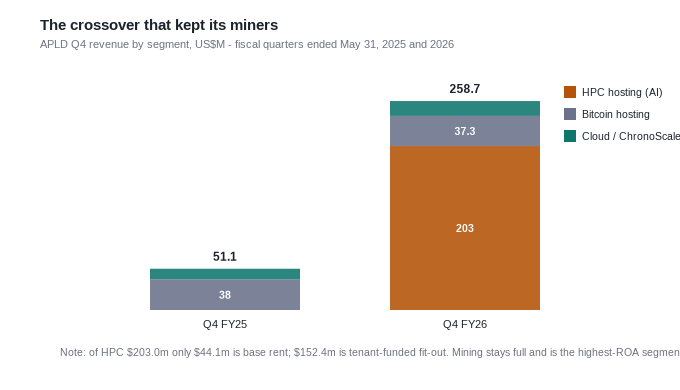
| Q4, US$M | FY25 (May 2025 q) | FY26 (May 2026 q) |
|---|---|---|
| HPC Hosting | ~0 (pre-revenue) | 203.0 |
| Data Center Hosting (bitcoin) | 38.0 | 37.3 |
| Cloud Services / ChronoScale | 13.1 | 18.4 |
| Total | 51.1 | 258.7 |
The AI line exploded. The mining line didn't move. North Dakota's two hosting campuses are full at 286MW — largest customer Marathon Digital, named in the company's own deck — and the segment posted $12.5M of operating income on $113.8M of assets: the best asset productivity in the company. The label "neocloud" describes where the growth is; the audited table shows why the company kept the old business: it is quietly the most efficient room in the building.
The growth headline needs one adjustment: of Q4's $203.0M HPC revenue, only $44.1M is base rent. The largest part — $152.4M — is tenant fit-out: reimbursed construction the tenant is paying for as the buildings come up. The recurring tail is real but younger than the headline; watch the rent line from here, not the total.
How you name a customer you can't name
Fiscal 2026's biggest event was a trio of leases signed within weeks: Delta Forge 1 (300MW, roughly $7.5bn), Polaris Forge 3 (300MW, roughly $7.5bn) and — just after quarter-end — Delta Forge 2 (210MW, about $5.2bn). Every document calls the counterparty the same phrase: "a new U.S. based, high investment-grade hyperscaler." The CEO counted the relationship itself as the disclosure: "one customer that has now chosen us three times in a row."
Anonymity here isn't legal fog — it's competitive structure. We have no independent evidence of who the party is, and the market's guesses are not a source. What the contracts do say is public and worth more:
- 15-year base terms with two 5-year renewal options — the same shape the hyperscalers sign with their biggest landlords. A neocloud getting hyperscaler-grade paper from an investment-grade counterparty is the credential the category lacked.
- Take-or-pay — the tenant pays whether the halls run or not. Demand risk sits on the renter's side of the line.
- Tenant-funded fit-out — the $152.4M reimbursement pattern above: the customer is paying to equip the building, not just occupying it.
- And where the financing needed names, the anonymity cracked by accident: the March 2026 8-K pricing $2.15bn of notes says plainly that Polaris Forge 2 is "currently leased to Oracle." Marketing keeps the list closed; capital markets make it specific. (Our contract-matrix article maps the whole leak pattern.)
The spin that wasn't a sale
In May 2026 Applied Digital pushed its third business — the Cloud Services segment (ChronoScale) — into a Nasdaq listing via merger with Ekso Bionics, and came out owning about 96% of it, still consolidated. Every non-GAAP metric now excludes ChronoScale. Read correctly, this is a re-labeling, not an exit: the company's own framing is "evolve into a pure-play data center platform" — keep the mining hosts (best ROA), list off the cloud reseller business (declining: $71.6M vs $84.4M as GPU prices fell), and make the remaining two segments tell one story. Whether 96%-owned-and-consolidated counts as "pure-play" is an auditor's question with an obvious tension; the strategy question — what belongs in a neocloud — gets answered by the exclusion list, not the org chart.
There is also a quieter line in the same release: a memorandum with CoreWeave to hand the Polaris Forge 1 Building 4 lease to a CoreWeave subsidiary once CoreWeave reaches investment grade. A landlord negotiating the credit rating of a tenant as a transfer condition tells you the whole market is being repriced around one axis — who can sign 15-year paper without a backstop.
What this order book cannot answer
- The identity of ~$20bn of revenue. Two of three tenants are adjectives. The $36bn book is exactly as diversified as the anonymized parties' plans allow.
- Delivery risk. The fit-out revenue concentration means the P&L is currently riding on construction schedules at five simultaneous campuses. A delayed energization converts reimbursement revenue into penalty exposure. The lease paper is take-or-pay; the concrete is not.
- The cost of capital gap. Applied Digital's Polaris Forge 2 notes priced at 6.75%; IREN's Microsoft-contract financing came at 6.0% investment grade. Same asset class, ~75bp apart, and the difference is counterparty names on paper. Rate-sensitive expansion is a different business than rate-protected expansion.
- What mining's 286MW does next. The segment's economics are the best in the building while bitcoin's own risk factor (halvings, price) stays outside this window's scope. A dual-track company is also a company with two futures.
Who are Applied Digital's AI customers?
How big is the contract book?
Is Applied Digital still a bitcoin company?
Why does "take-or-pay" matter so much?
What was the ChronoScale transaction?
- Primary: APLD FY26 Q4/full-year results 8-K, filed July 27, 2026 (fiscal year ended May 31, 2026), read verbatim; segment lines as reported (HPC fit-out/reimbursements breakdown per company). The FY full-year Data Center Hosting revenue is not separately disclosed in the release text we read; we quote quarterly DCH only.
- Order-book figures (1,410MW; $36bn base / $86bn all-options; $20bn trio; 175MW in service; 1.7GW being marketed) are company-stated expectations from the same release and the April 2026 investor presentation (8-K ex-99.2, read in full).
- Oracle/Polaris Forge 2 quote from the 8-K of March 4, 2026 ($2.15bn 6.750% senior secured notes due 2031, "currently leased to Oracle"); CoreWeave PF1 terms from the deck and the 2025-10-22 presentation.
- IREN 6.0% financing comparison from IREN's Aug 27, 2026 release (separate article). Cross-company comparison of stated coupon levels is arithmetic, not a credit opinion.
- Counterparty identities stay as filed; no market guesses used. No investment advice.
Sign up, paste one config line, connected in 15 seconds. Then just ask it in the conversation.