 Dicaria
The AI data center backlash has a legal vocabulary now - you can date it in SEC filings
"AI data center" and "moratorium" appeared together in 3 SEC filings in 2023. In 2026 they appear in 124. The exact phrase "data center moratorium": zero before 2026, eleven this year - including a Meta shareholder proposal citing six Indiana county bans. The older version of the same fear, a crypto-mining moratorium, is dying out (102 down to 50). And by February 2026 the vocabulary had left the risk chapter: in the contract selling Century Aluminum's Kentucky plant to TeraWulf's data-center arm, the "HPC/AI data center campus" is what the $200 million transaction is defined to buy.
Two layers, one migration. The loose risk pairing — "AI data center" and "moratorium" in one SEC filing: 3 (2023) to 124 (2026), while the crypto-mining version retires (102 to 50). The exact phrase "data center moratorium": zero before 2026, eleven by November — merger documents, REIT reports, and a Meta shareholder proposal citing six Indiana county bans. By February 2026 the vocabulary had left the risk chapter: "HPC/AI data center campus" is now the defined purpose of a $200M land sale.
How a fear becomes a legal vocabulary
Regulatory backlash shows up in press before it shows up in law, but press does not bind anyone. The first place an opposition movement becomes legally consequential language is a public company's filing. The journey has stages: a worry mentioned in a risk factor, then a named risk ("the X moratorium"), then — if the movement matters commercially — a term inside contracts that price it, condition on it, or define assets by it.
We tracked the stages through SEC full text, by filing year, two ways:
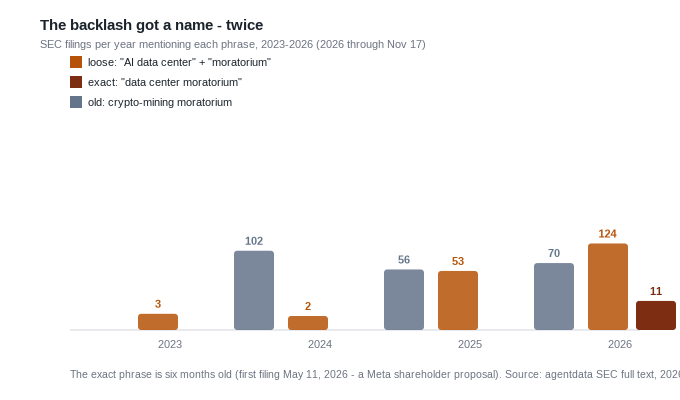
- The loose pairing ("AI data center" in the filing plus "moratorium" anywhere): 3, 2, 53, 124. This is the risk-sentence layer, lawyers adding a clause to the hedging paragraphs.
- The exact phrase ("data center moratorium", adjacency required): 0, 0, 0, 11. This is the naming layer — the fear now has a noun. All eleven 2026 filings arrived inside six months (May 11 to November 16): Blockfusion's merger documents (four), a Meta shareholder proposal (PX14A6G, May 2026), two REIT quarterly reports (Lightstone, Blackstone Digital Infrastructure Trust), an acquisition proxy, UNIFI's annual report and WhiteFiber's 8-K/A.
- The predecessor phrase ("crypto mining" plus moratorium): 102 in 2023, down to 50 in 2026. The same lawyerly fear, retargeted in three years.
The generic line (any "data centers" plus moratorium: 1,132 to 1,685) mostly measures noise, boilerplate about local permitting. The two specific layers are the signal; every filing behind them is retrievable by company.
Where the eleven exact-phrase filings sit
Five of the eleven belong to Blockfusion Digital Infrastructure, a crypto-to-AI converter writing "data center moratorium" into the merger documents of its own SPAC-style deal — the risk named inside the transaction that depends on the asset class. Two belong to REIT quarterly reports (Lightstone, Blackstone's new Digital Infrastructure Trust) pricing it as property risk. And one is the most telling: a May 2026 shareholder proposal at Meta (filed by As You Sow and co-investors, PX14A6G) demanding Meta report how its data-center buildout squares with its climate commitments — citing, in its own words, "proposed moratoriums on new data centers... passed or introduced across 18 states" and noting that in Indiana, where Meta had just broken ground on a $10bn campus, six counties enacted moratoriums, while "Federal lawmakers have proposed a federal moratorium."
The fear is no longer only in the company's mouth. It is in the investors' argument.
17 companies: who wrote it first?
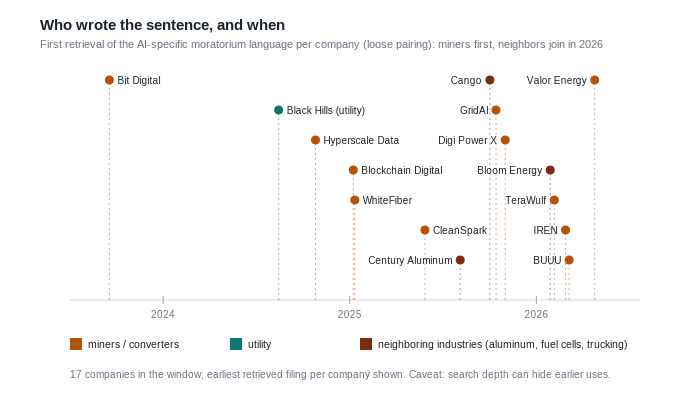
First wave (2024-2025), miners and their orbit: Bit Digital in March 2024, then Black Hills (February 2025 — a South Dakota electric/gas utility, the first non-miner, hedging its own growth segment), Hyperscale Data, WhiteFiber, Blockchain Digital, CleanSpark.
Second wave (2026), and this is the interesting one: Century Aluminum (February), Cango, GridAI, Digi Power X, TeraWulf, IREN, Bloom Energy (July), CleanCore, Z Squared, BUUU, Valor Energy. A fuel-cell maker that sells on-site power to data centers (Bloom) and a listed truck-efficiency company (Cango) now disclose AI-moratorium risk. The sentence is no longer niche — by 2026 it crosses from "our factory is the data center" (miners) to "our customer is the data center" (Bloom, Century).
One note on the counts: "first appearance" per company means the first filing we retrieved that names the phrase. Early hits can sit behind search cutoffs. The curve direction and the 2026 industry spread are robust; single-company-first dates are indicative.
What the filings were afraid of, in the real calendar
The curve is not paranoia — it tracks a legislatures' work. Compressed timeline (each item dated from the record cited in the data notes):
- Nov 5, 2025 — New Jersey's governor signs the data-center cost package: a separate rate class so facilities can't push grid costs onto households, cost-causation rules above 50MW.
- May 2025 (federal). A House bill carries a ten-year restriction on state AI regulation. A committee amendment to delete it fails 24-29. The Senate later strips the provision. The moratorium-era vocabulary was briefly national, in both directions.
- 2025-2026 (municipal, NJ and now Indiana). Six New Jersey towns enact or vote on data-center bans, Millville among them. A 1,500-signature petition forms around CoreWeave's $1.8bn Kenilworth site, and its $250M state credit later draws a bill to claw it back. In Indiana, by May 2026, six counties around Meta's $10bn site had enacted moratoriums of their own — counted in an investor proposal, not a press release.
- Mar 23, 2026 (federal regulator) — FERC denies the PJM market monitor's complaint (docket EL26-30) that would have kept large loads out of the grid until generation existed.
- Still pending as of this writing — NJ A796 (large loads prepay 85% of requested power for ten years), S3379 (semi-annual water/energy reporting), S680 (renewable/nuclear sourcing for new AI and mining facilities); federal H.R. 7858/8488 (impact study, 180-day disclosure).
Every item above exists after the corresponding filings began naming "AI data center moratorium" as a risk in 2024-2025. The risk chapter is the canary: companies priced the movement roughly six to twelve months before it produced statutes and dockets.
The vocabulary enters the transaction
On February 2, 2026, Century Aluminum of Kentucky signed a purchase-and-sale contract with Justified DataPower LLC for the Hawesville plant. Hawesville is the same Kentucky town where TeraWulf's Anthropic campus is rising — Justified is TeraWulf's site vehicle. The contract shows what stage two looks like. Read the money clauses:
- Section 2.4 prices the deal in two parts: $200M cash plus a 6.8% non-dilutive equity interest in the "Project Company" that will "own and develop any and all high-performance computing / artificial intelligence (HPC/AI) data center project to be developed and constructed on the Real Property." The seller keeps a stake in the backlash-targeted asset.
- Section 6.15 has the seller representing that nothing it knows would harm "Purchaser's development of an HPC/AI data center campus on the Property." The development use is a warranted object of the contract, not a hope in a slide.
- Section 5.2 choreographs the power handover. The seller terminates its contracts with Big Rivers Electric Cooperative and Kenergy. The buyer pursues a new energy-services agreement that needs Kentucky Public Service Commission approval. The grid fight is already in the plumbing.
- And moratorium? It appears twice, in the standard enforceability carve-out ("subject to bankruptcy, insolvency, fraudulent transfer, reorganization, moratorium and similar laws") — the boilerplate of contract law, which has always reserved a place for government suspensions of obligation.
That is what the document supports, and it is still mid-migration. The exact risk phrase ("data center moratorium") has not yet become a closing condition in this contract — but "HPC/AI data center" has become the defined purpose of a $200M land transaction. The backlash object is now an asset class with equity structures around it. The next milestone is when the moratorium clause moves from enforceability boilerplate into a bespoke condition precedent: a deal that can die specifically by AI freeze. When that happens, a phrase-and-form query will catch it.
What this data cannot tell you
- Whether people protested. No filing measures rallies, petitions, or town-hall attendance. The press events we date are proxies, not aggregates.
- Whether moratoria were enacted. New Jersey enacted a cost law, not a freeze. The town bans are municipal and partial. The curve counts the fear language, and fear language outruns enacted law by design.
- Whether the risk is real for each filer. A trucking-efficiency company filing AI-moratorium risk is mostly hedging its customer concentration. We flag Bloom and Cango as "customer-side" hedges, not operators.
- The national total. 124 filings is what the phrase search returns in the SEC corpus; state legislatures and courts have their own text we do not count here.
What is a data center moratorium?
Why did crypto-mining moratorium language decline?
Which states are actually doing this?
Does more risk language mean more risk of losing money?
Are moratoriums actually being enacted?
- Phrase layers: SEC EDGAR full-text (agentdata, pulled 2026-11-17), by filing year, all forms. Loose pairing
"AI data center"+moratorium(same document, adjacency not required) = 3/2/53/124 (2023/2024/2025/2026-to-Nov 17); exact phrase"data center moratorium"= 0/0/0/9 plus"moratorium on data centers"= 2 in 2026 (UNIFI 10-K, WhiteFiber 8-K/A, both 2026-08-26); predecessor"crypto mining"+moratorium = 102/56/70/50; generic"data centers"+moratorium = 1,132/1,206/1,459/1,685. Word order does not change AND counts (spot-checked both ways). - The eleven exact-phrase 2026 documents: Blockfusion Digital Infrastructure S-4/A (Jun 30, Sep 23, Oct 16) and 424B3 (Oct 23); Blue Acquisition DEFM14A (Oct 23); Lightstone Value Plus REIT I 10-Q (Nov 13); Blackstone Digital Infrastructure Trust 10-Q (Nov 16); Meta PX14A6G (May 11 — As You Sow et al. proposal; its memo (our count of its citations) points to 18 states with moratorium activity, six Indiana counties, and a federal moratorium proposal, each with its own press sourcing).
- Adoption list: companies whose filings contain the AI-specific phrase 2025-06 to 2026-11 in 8-K/6-K/10-K/10-Q; deduplicated by registrant; first/last dates are first/last retrieved filings (search-depth caveat in text). 17 companies listed in the chart.
- Century Aluminum / Justified DataPower Agreement of Purchase and Sale, dated February 2, 2026 (8-K exhibit 10.1, read in full): "HPC/AI data center" appears in the price structure (Section 2.4: $200M cash + 6.8% non-dilutive Project Company equity) and the diligence representation (6.15); power-transition mechanics in 5.2 (Big Rivers/Kenergy, Kentucky PSC approval). "Moratorium" appears only inside the standard enforceability carve-out (6.2/8.2) — we checked: it is not in the closing conditions (4.2). Justified DataPower's relationship to TeraWulf is stated in the agreement's own definitions (TeraWulf Inc. named as "an affiliate of Purchaser"). Our summary, not a legal opinion.
- New Jersey: cost package signed November 5, 2025 (separate rate class; 50MW threshold in the amended Senate bill). Municipal bans across six towns including Millville; Kenilworth CoreWeave site $1.8bn with $250M state credit approved November 2025 and a 1,500-signature petition; claw-back bill reported May 2026, not enacted. Federal: House package carried a 10-year state-regulation restriction May 2025 (committee amendment to remove failed 24-29; provision stripped in Senate). FERC complaint (Monitoring Analytics) denied in Docket EL26-30, March 23, 2026. Bills A796/S3379/S680 and H.R. 7858/8488: pending as of November 17, 2026.
- Legal-event facts are from dated news reports of the legislative record (WHYY, NJ Ballot, NJ Today), cross-consistent on dates and vote counts; where sources conflict, the later official-signing date is used. These are not SEC filings and are labeled as press-of-record.
- No investment advice; no forecast of any bill's fate.
Sign up, paste one config line, connected in 15 seconds. Then just ask it in the conversation.